



RemNote vs StudyCards AI
Side-by-side comparison of features, pricing, ratings, and alternatives.
RemNote combines note-taking, flashcard creation, PDF annotation, and AI-powered study tools into one app built around helping students retain what they learn, not just record it. Notes can be automatically or manually converted into flashcards, which are then reviewed using a spaced repetition algorithm that schedules reviews at optimal intervals for memory retention. Beyond flashcards, RemNote supports PDF and PowerPoint annotation, typed and handwritten notes, an AI tutor chat, and databases for organizing course material, positioning itself as a replacement for juggling separate tools like Quizlet, Anki, Notion, and Evernote.
StudyCards AI is an AI-powered flashcard generation tool that converts uploaded PDF documents into study flashcards automatically, then exports them directly into Anki for spaced-repetition review. It generates both standard question-answer cards and cloze-style (fill-in-the-blank) cards, with the AI able to interpret diagrams in source files and attach relevant visuals to generated cards.
- Combines note-taking and spaced-repetition studying in one app instead of two separate tools
- Generous free plan includes unlimited notes and flashcards
- PDF annotation and image occlusion are useful for STEM and visual subjects
- Offline mode with cross-device sync
- Fast way to turn existing PDFs/notes into review-ready flashcards
- Direct Anki export leverages Anki's proven spaced-repetition engine
- Diagram recognition adds visuals automatically, useful for visual subjects like anatomy
- Affordable entry-level pricing ($4.99/month)
- Free plan caps PDF annotation, image occlusion cards, and handwritten documents fairly low
- Full AI feature set (lecture recorder, AI grading) requires the pricier Pro with AI tier
- Learning curve for students used to simpler flashcard-only tools like Quizlet
- No free tier beyond a trial - fully paid product
- Small, independently-run product rather than a large established company
- Deck-count limits even on the top tier (100 decks) may constrain heavy users
More alternatives & similar tools
Alternatives to RemNote
View all →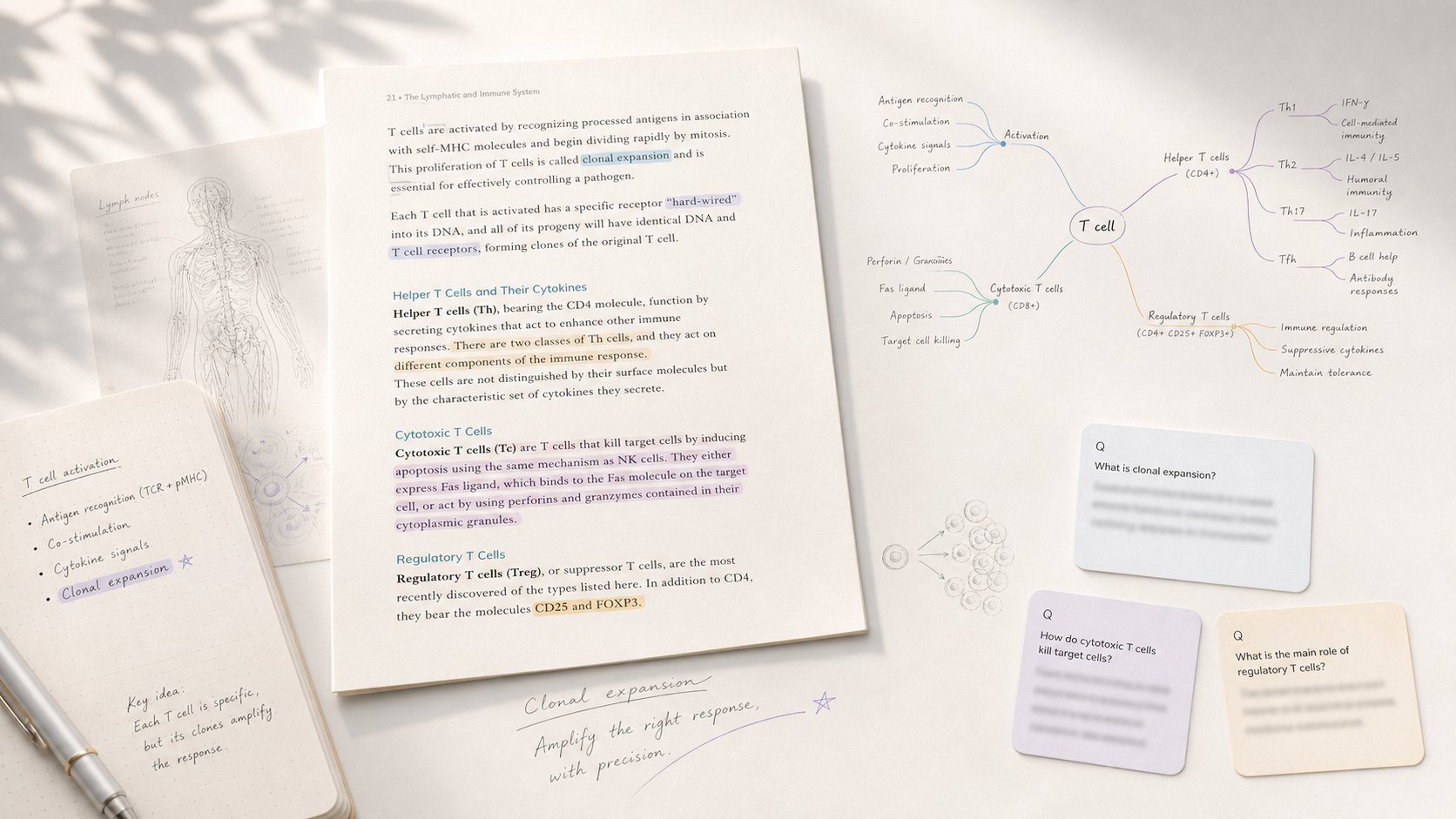
Study app that turns PDF/EPUB annotations into mind maps and spaced-repetition flashcards.

All-in-one study platform with flashcards, notes, and AI-generated practice exams

Turns lecture slides, PDFs, and recordings into an AI tutor that knows your course material

Alternatives to StudyCards AI
View all →All-in-one study platform with flashcards, notes, and AI-generated practice exams
Turns lecture slides, PDFs, and recordings into an AI tutor that knows your course material
AI note-taking app that turns notes into flashcards with spaced repetition to help you actually learn.
Study app that turns PDF/EPUB annotations into mind maps and spaced-repetition flashcards.
The Verdict
AI-generated from listing dataRemNote offers a free tier with unlimited notes and flashcards but limits advanced PDF and AI features, while StudyCards AI is a paid‑only tool that quickly turns PDFs into Anki decks but caps deck counts.
Key differences
- •RemNote includes built‑in spaced‑repetition, note‑taking, and PDF annotation; StudyCards AI focuses solely on PDF‑to‑Anki flashcard conversion.
- •RemNote has a generous free plan; StudyCards AI requires a subscription for any use.
- •RemNote syncs across devices and works offline; StudyCards AI is cloud‑only with no offline mode.
- •StudyCards AI exports directly to Anki’s engine; RemNote uses its own SR algorithm.
- •RemNote limits advanced PDF annotation and AI features on free tier; StudyCards AI imposes deck‑count limits even on paid tiers.
Pricing & value
RemNote’s freemium plan provides unlimited notes and flashcards; StudyCards AI has no free tier.
Ease of use / learning curve
StudyCards AI’s single‑purpose PDF‑to‑Anki workflow is simpler than RemNote’s combined note‑flashcard system.
Features & depth
RemNote offers note‑taking, spaced‑repetition, PDF/PowerPoint annotation, image occlusion, AI tutor, offline sync.
Integrations & ecosystem
StudyCards AI integrates directly with Anki, leveraging its established spaced‑repetition engine; RemNote has no Anki export.
Collaboration
RemNote provides cloud sync and cross‑device access; StudyCards AI does not mention collaboration features.
Scalability
RemNote’s unlimited notes and flashcards scale for heavy users; StudyCards AI caps decks at 100 even on top tier.
Support
Both offer email/help‑center support; no additional details to differentiate.
Choose RemNote if…
Students who want a free, all‑in‑one note‑taking and flashcard tool with offline sync.
Choose StudyCards AI if…
Students (e.g., med students) who need rapid PDF‑to‑Anki flashcards and are willing to pay for a focused solution.
Common questions
Can I use either tool for free?
RemNote has a free plan with unlimited notes; StudyCards AI has only a trial, then requires subscription.
Do they work with Anki?
StudyCards AI exports decks directly to Anki; RemNote uses its own spaced‑repetition system and does not export to Anki.
What limits exist on PDF annotation?
RemNote’s free tier caps PDF annotation, image occlusion, and handwritten docs; StudyCards AI has no annotation limits but caps deck counts.