



Anki vs MarginNote
Side-by-side comparison of features, pricing, ratings, and alternatives.

Anki is a flashcard application built around spaced repetition, using an algorithm to schedule reviews so learners spend more time on challenging material and less on cards they already know well. It is free and open source on desktop (Windows, macOS, Linux), with source code publicly available on GitHub and an extensible add-on ecosystem built by the community.
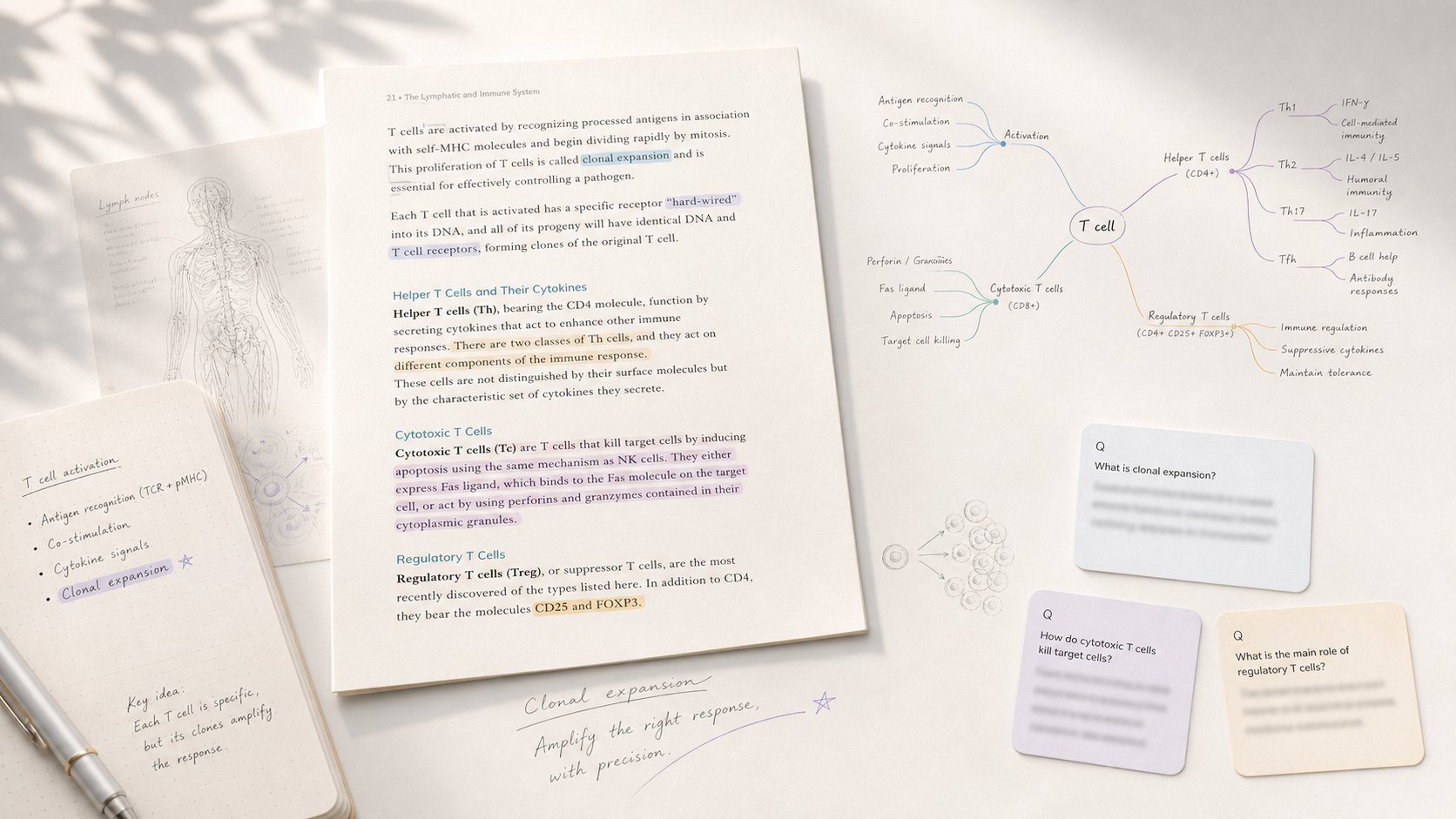
MarginNote is a study and knowledge-management app for Mac and iPad, positioned as a place 'where deep reading leaves a trace.' It integrates PDF/EPUB annotation, mind mapping, and an FSRS-based spaced-repetition flashcard system so that highlights and notes automatically become study cards across multiple linked formats.
- Completely free and open source on desktop and Android
- Highly customizable via add-ons
- Proven spaced-repetition algorithm with a long track record
- Handles massive decks without performance issues
- Tightly integrates reading, mind mapping, and flashcards into one workflow
- FSRS-based spaced repetition is more efficient than legacy algorithms
- Multiple purchase options including lifetime licenses
- Popular with medical, law, and language-learning students for exam prep
- Steeper learning curve and dated UI compared to modern flashcard apps
- AnkiMobile (iOS) requires a one-time paid purchase
- No built-in AI content generation like some newer competitors
- Not available on Windows or Android
- Lifetime plan's AI credits stop after 3 years even though the software keeps working
- Steeper learning curve due to the depth of mind-mapping and linking features
More alternatives & similar tools
Alternatives to Anki
View all →
AI note-taking app that turns notes into flashcards with spaced repetition to help you actually learn.
Study app that turns PDF/EPUB annotations into mind maps and spaced-repetition flashcards.

All-in-one study platform with flashcards, notes, and AI-generated practice exams
Alternatives to MarginNote
View all →The Verdict
AI-generated from listing dataAnki is a free, open‑source flashcard system focused on spaced‑repetition, while MarginNote bundles PDF/E‑pub annotation, mind‑mapping, and AI‑assisted flashcards at a freemium cost.
Key differences
- •Anki is purely a flashcard app; MarginNote combines reading, annotation, mind‑maps, and flashcards.
- •Pricing: Anki is completely free (except optional iOS app); MarginNote uses a freemium model with paid lifetime licenses.
- •Platform support: Anki runs on Windows, macOS, Linux, Android, iOS; MarginNote only on iPad and Mac (iOS/macOS).
- •Spaced‑repetition algorithm: Anki uses the classic SM‑2; MarginNote uses FSRS, claimed 30% more efficient.
- •AI features: MarginNote offers AI‑generated summaries and quiz creation; Anki has no built‑in AI.
Pricing & value
Anki is fully free; MarginNote requires paid plans for full features.
Ease of use / learning curve
Both have steep curves, but Anki’s UI is simpler than MarginNote’s multi‑tool interface.
Features & depth
MarginNote adds PDF/E‑pub annotation, mind‑maps, AI summaries, and OCR beyond flashcards.
Integrations & ecosystem
Anki offers extensive community add‑ons and open‑source code; MarginNote has no API or open ecosystem.
Collaboration
Neither product mentions built‑in collaboration features.
Scalability
Anki handles decks >100,000 cards; MarginNote’s capacity not specified.
Support & updates
MarginNote provides iCloud sync and regular updates; Anki relies on community support, no official API.
Choose Anki if…
Students or professionals needing a free, high‑capacity flashcard system without extra reading tools.
Choose MarginNote if…
Heavy readers/researchers who want integrated annotation, mind‑mapping, and AI‑enhanced flashcards on iPad/macOS.
Common questions
Is there any ongoing cost for using Anki?
Anki is free on desktop and Android; iOS requires a one‑time purchase, all other features remain free.
Can MarginNote run on Windows or Android devices?
No, MarginNote is only available for iPad and Mac (iOS/macOS).
Which tool supports AI‑generated study material?
MarginNote includes AI‑assisted summaries, key‑term extraction, and quiz generation; Anki has no built‑in AI.