
FindAlternative
Back to Home
PaperLens

PaperLens

Find truth in the research
softwareAI Research & AnalysisAI research assistantscientific literature searchevidence-based answers

What is PaperLens?

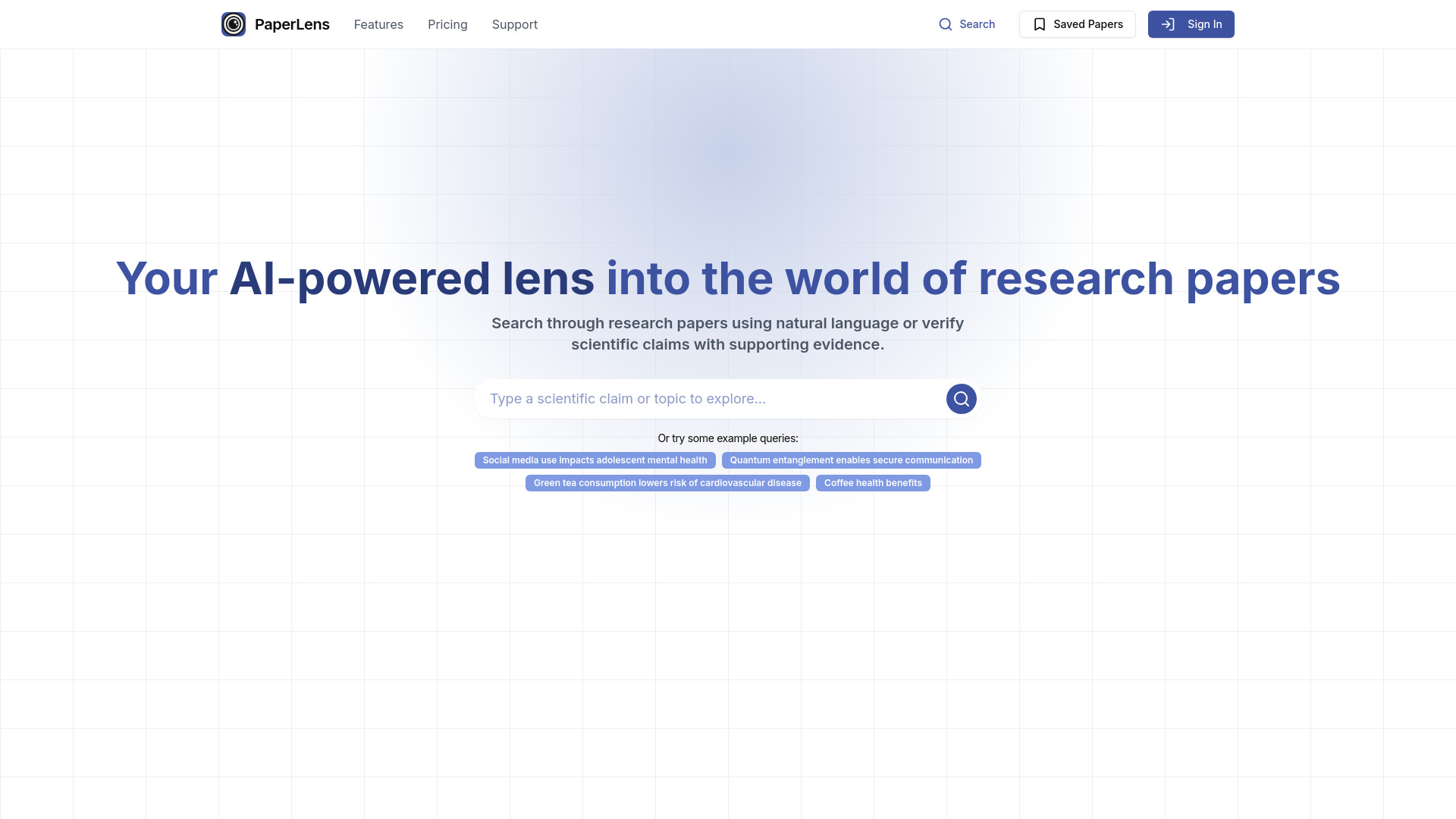
PaperLens is an AI-powered research assistant that provides evidence-backed answers grounded in millions of peer-reviewed papers. It helps researchers, students, and professionals quickly find, understand, and organize scientific literature.

SpecificationsAI-estimated

PricingStarter $8/month (billed yearly), Pro $20/month (billed yearly)
Free TrialNo credit card required
Data SourcesarXiv, Crossref, Semantic Scholar
Core FeaturesResearch answers, research copilot, save & break down papers, smart filtering

Key Features of PaperLens

AI answers grounded in millions of peer-reviewed papers
Evidence strength, consensus, key findings, and limitations
Conversational research copilot with follow-up questions
Paper library and structured wiki summaries
Filter by date, quality, and source
Semantic search across scientific literature

Use Cases for PaperLens

1

Evidence-based Research

Get AI-generated answers backed by peer-reviewed papers to support academic or professional claims.

2

Scientific Literature Review

Quickly explore claims and research topics without manually reading dozens of papers.

3

Paper Organization

Save papers and generate structured summaries for efficient knowledge management.

How to use PaperLens?

1

Visit PaperLens

Go to https://thepaperlens.com/ and sign in or explore example queries.

2

Enter a claim or question

Type any research question or claim, such as 'Are genetically modified crops safe for human consumption?'

3

Review evidence-backed answers

Analyze findings, evidence strength, consensus, and limitations presented by the AI.

4

Save and organize papers

Build your library and generate structured summaries for future reference.

Pros & Cons of PaperLens

Pros

  • Answers grounded in real peer-reviewed papers
  • Shows evidence strength, consensus, key findings, and limitations
  • Supports follow-up questions and paper deep-dives
  • Real-time web search integration
  • Save papers and generate structured wiki summaries
  • Advanced filtering by date, quality, and source
  • Transparent pricing with free tier available

Cons

  • Starter plan limited to 500 searches per month
  • AI-based analysis may still require user verification
  • Relatively new platform with limited community reviews

Frequently Asked Questions

What makes PaperLens different from ChatGPT?

PaperLens grounds every answer in real peer-reviewed papers and shows evidence strength, consensus, key findings, and limitations.

Do I need a credit card to try PaperLens?

No, PaperLens does not require a credit card to get started.

What sources does PaperLens use?

PaperLens uses arXiv, Crossref, and Semantic Scholar.

Pricing Overview

View full pricing →
Paid (Subscription)

PaperLens offers two subscription tiers: Starter at $15/month or $8/month billed annually, and Pro at $50/month or $20/month billed annually.

Starter

$15/month or $8/month (billed annually)

Pro

$50/month or $20/month (billed annually)

No reviews yet. Be the first to write one!

Top Alternatives & Similar Software

View all alternatives & similar software→


BGPT (BioGPT)

BGPT (BioGPT)

AI-suggested

BGPT is an evidence layer for scientific AI, designed to present scientific claims with supporting evidence, scope, and limitations instead of unsupported assertions. It operates as both a web resource and an MCP (Model Context Protocol) integration, making evidence-qualified scientific statements available to tools like Claude, Cursor, and other compatible AI assistants. Each claim is paired with one evidence-qualified sentence and linked to a full evidence page for deeper verification. The homepage organizes current evidence into six scientific domains: microbiome and infectious disease, genomics/evolution/development, neuroscience/behavior, human health/medicine, AI methods/biosecurity, and ecology/origins of life. Example claims span topics from jellyfish sleep regulation and urolithin A longevity to avian song complexity and LLM-assisted systematic reviews. Rather than merely presenting findings, BGPT scores papers for quality, novelty, and reproducibility, and explicitly states limitations next to each conclusion. This makes BGPT useful for researchers, clinicians, students, and anyone relying on AI-generated or rapidly summarized scientific information. Its emphasis on completeness and caution—acknowledging when evidence is mechanistic, underpowered, or model-derived—helps reduce over-citation and scientific misinformation. The service is particularly relevant for professionals working with AI assistants who need source-grounded, limitation-aware evidence.

People also viewed

Related searches

About the Product

Unclaimed Listing
Platforms
Target AudienceResearchers, students, academics, science communicators, and professionals who need evidence-based answers from scientific literature.

Is this your tool?

Claim this page to update details, reply to user reviews, and drive more traffic to your product.

Claim this Product →

Show you’re listed

PaperLens on FindAlternative

Add this badge to your website. It links back to this page.

Get your badge →

Tags

AI research assistantscientific literature searchevidence-based answersacademic researchpaper analysis

Keep up with PaperLens alternatives

New alternatives, pricing changes and the week's biggest movers - one email every Tuesday.

Weekly, free, unsubscribe in one click.