




Logic
From plain English to production agent in 60 seconds.
What is Logic?
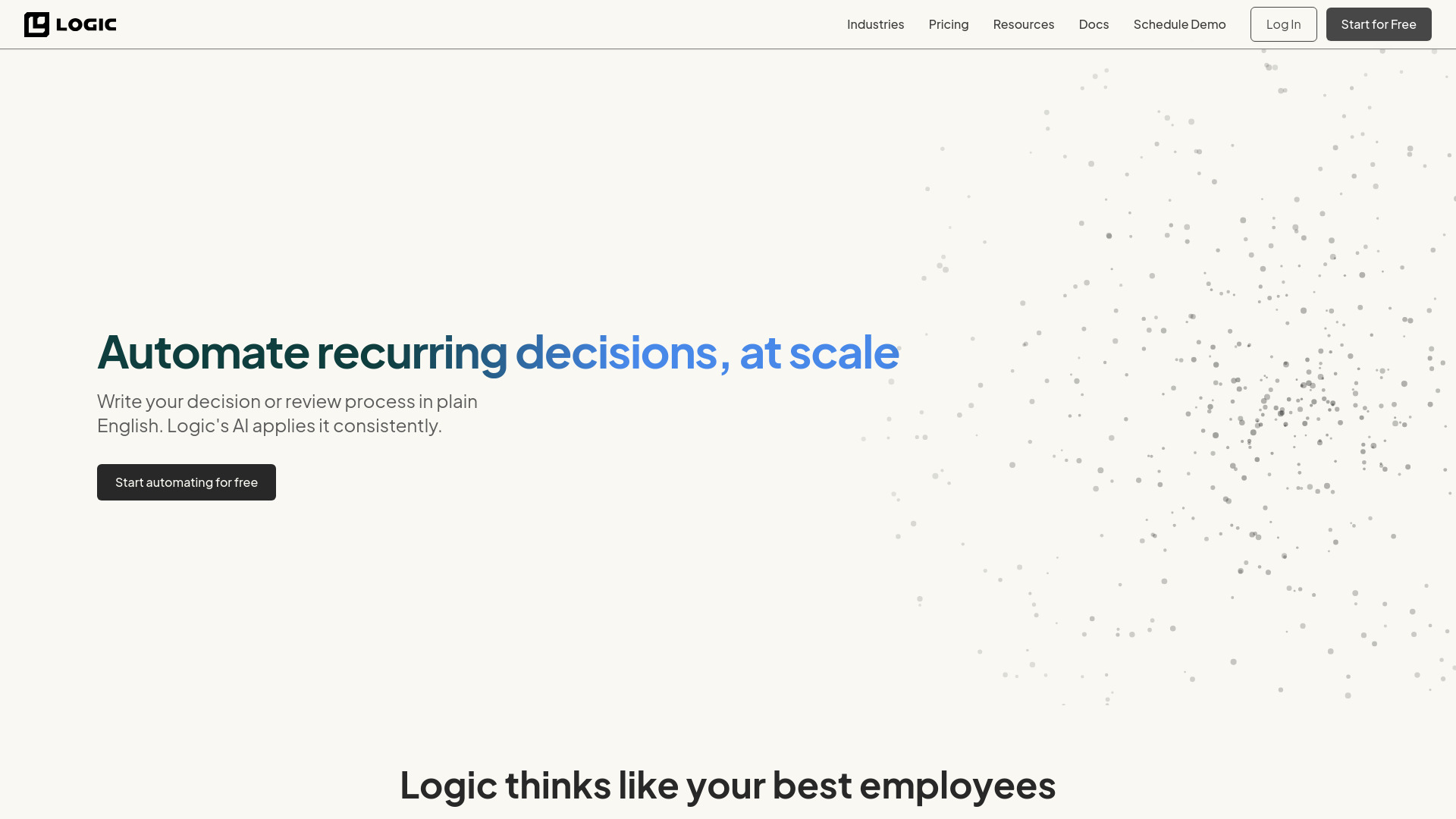
Logic is a spec-driven agent platform that turns plain-English descriptions into production-ready AI agents in under 60 seconds. Instead of building flowcharts, frameworks, or custom eval pipelines, teams write a spec that defines behavior, inputs, and outputs. Logic then generates a tested, versioned, and deployable agent with a strictly typed REST API, a shareable web UI, and an MCP server for integration with tools like Claude, Cursor, and ChatGPT.
SpecificationsAI-estimated
Key Features of Logic
Use Cases for Logic
Contract Clause Analysis
Flag risky clauses and extract key terms from any contract using a ready-made agent template or a custom spec.
PII Redaction
Detect and redact personal data from text while generating a detailed report of what was found.
Invoice and PO Processing
Extract structured line items from invoices and purchase orders with multi-format parsing and line-item extraction.
Product Listing Moderation
Approve, reject, or escalate product listings against your policy with instant moderation decisions.
Resume Screening
Score resumes against a job description with transparent fit scoring and skill and experience matching.
Support Ticket Classification
Triage tickets by priority, sentiment, and category with intent-based routing and sentiment analysis.
Entity Matching
Match records across systems with weighted confidence scores and field normalization.
Onboarding Personalization
Tailor the first-run experience from signup context with company and role enrichment and industry detection.
How to use Logic?
Start with a template or blank spec
Choose a pre-built agent template such as PII Redactor or Contract Clause Analyzer, or fork one and start from your own plain-English description.
Write your spec
Define the agent's behavior, inputs, and outputs in plain English. No frameworks, SDKs, or flowcharts are required.
Test before shipping
Use the built-in test harness to add inline test cases with expected outputs. Logic runs the suite on save and catches regressions automatically.
Deploy and integrate
Save the agent to expose it as a strictly typed REST API with auto-generated docs, a shareable web UI, and an MCP server for AI tool integration.
Monitor and iterate
Review full execution logs, latency, and errors. Update the spec anytime with versioning and rollback to keep the API stable.
Pros & Cons of Logic
Pros
- Extremely fast deployment: a spec becomes a tested, versioned API in under 60 seconds
- Built-in testing, versioning, and rollback reduces the need for separate eval and prompt management tools
- Automatic model routing across OpenAI, Anthropic, Google, and Perplexity with failover
- Strictly typed REST API, auto-generated docs, MCP server, and shareable web UI are included
- SOC 2 Type II and HIPAA certified with a 99.9% uptime SLA
Cons
- No self-hosting or on-premises option is mentioned; teams must rely on Logic's cloud
- The website does not list transparent pricing, so cost is unclear until you start free or contact sales
- Agents depend on third-party model providers, so availability and behavior can be affected by upstream provider issues
- Organizations needing fully custom model routing or bespoke infrastructure may find the managed approach constraining
Frequently Asked Questions
How long does it take to deploy a production agent with Logic?
Under 60 seconds. Describe what your agent should do in plain English, and Logic generates a typed, tested, versioned API endpoint immediately.
What does Logic handle that I'd otherwise build myself?
Logic handles the infrastructure stack most teams build before their first AI feature goes live: schema validation and typed APIs, model routing and retry logic, automated testing and versioning, and full execution logging.
What AI models does Logic support?
Logic automatically routes requests to the optimal model across OpenAI, Anthropic, Google, and Perplexity. Routing decisions are based on task complexity, cost, and latency requirements.
Is Logic SOC 2 certified?
Yes. Logic is SOC 2 Type II certified and HIPAA certified, with annual audits. Data is encrypted in transit and at rest, with strict access controls and full audit logging. Logic does not train on your inputs or outputs.
Can I update my spec without breaking the API?
Yes. You can update decision rules anytime without redeploying. API contracts stay stable, and every change is validated and versioned. Built-in rollbacks let you revert instantly if needed.
What use cases work best with Logic?
Logic works well for document processing, content moderation, scoring and classification, content optimization, voice processing, and custom internal workflows. Garmentory uses Logic to moderate 5,000+ product listings daily, and DroneSense uses it to process complex purchase orders in two minutes instead of thirty.
How reliable is Logic?
Logic has a 99.9% uptime SLA, which is consistently exceeded in practice. Logic runs on redundant infrastructure with automatic failover.
Reviews & Ratings0.0
No reviews yet. Be the first to write one!
Top Alternatives & Similar Software
View all alternatives & similar software→No alternatives available yet.
People also viewed



Related searches
Is this your tool?
Claim this page to update details, reply to user reviews, and drive more traffic to your product.
Claim this Product →
Tags
Explore Related Topics
Keep up with Logic alternatives
New alternatives, pricing changes and the week's biggest movers - one email every Tuesday.