



OpenCV vs moviepy
Side-by-side comparison of features, pricing, ratings, and alternatives.


OpenCV is a widely used open-source computer vision library that provides a wide range of functionalities for image and video processing, feature detection, object recognition, and more. It is widely used in various fields such as robotics, medical imaging, and surveillance.
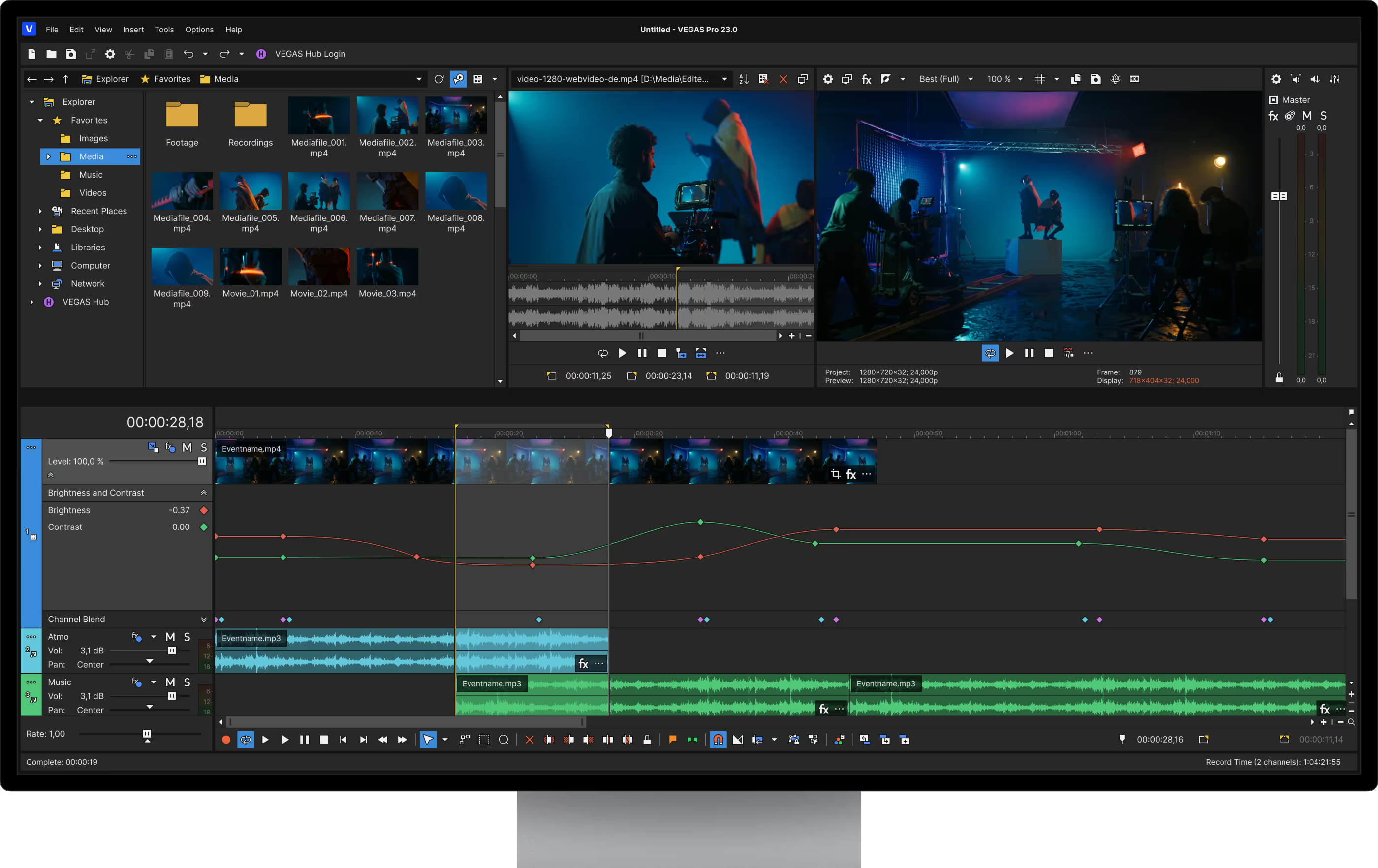
MoviePy is a Python library for video editing, which can be used for basic operations such as video trimming, concatenation, and overlaying of text or images. It also supports more advanced operations such as color correction, audio editing, and video stabilization.
- Open-source and free to use
- Large community of developers and users
- Cross-platform compatibility
- Wide range of features and tools
- Easy to use and intuitive API
- Highly customizable and flexible
- Support for advanced video editing operations
- Free and open-source
- Steep learning curve
- Requires programming knowledge
- No end-user application or GUI — it is a developer library consumed from C++, Python, Java or JavaScript
- Limited support for 3D video editing
- Not suitable for real-time video editing
- Requires Python programming knowledge
More alternatives & similar tools
Alternatives to OpenCV
View all →


Alternatives to moviepy
View all →
The Verdict
AI-generated from listing dataOpenCV is the safer default for broad computer‑vision needs and deep‑learning integration, while moviepy excels for Python‑centric video editing tasks.
Key differences
- •OpenCV offers a massive library of vision algorithms and deep‑learning support; moviepy focuses on video editing and compositing.
- •OpenCV requires C++/Python/Java programming and has a steep learning curve; moviepy provides an intuitive Python‑only API.
- •OpenCV integrates with TensorFlow, PyTorch, and OpenCL; moviepy integrates mainly with Python, OpenCV, and FFmpeg.
- •OpenCV has a far larger community (90k+ GitHub stars) versus moviepy (15k stars).
- •OpenCV lacks a GUI end‑user app; moviepy also lacks a GUI but is easier for script‑based editing.
Pricing & value
Both are free and open‑source, offering high value at zero cost.
Ease of use / learning curve
moviepy is described as easy to use with an intuitive API, whereas OpenCV has a steep learning curve.
Features & depth
OpenCV provides a wide range of image/video algorithms, deep‑learning support, and real‑time processing; moviepy is limited to editing.
Integrations & ecosystem
OpenCV integrates with TensorFlow, PyTorch, OpenCL; moviepy integrates mainly with Python, OpenCV, FFmpeg.
Collaboration
OpenCV’s large community (90k+ stars) offers more collaborative resources than moviepy’s smaller community.
Scalability
OpenCV supports real‑time processing and can be deployed in robotics, medical imaging, etc.; moviepy is not suited for real‑time editing.
Support
OpenCV offers community forum and GitHub Issues; moviepy offers email and GitHub Issues, but OpenCV’s larger community provides broader support.
Choose OpenCV if…
Developers needing comprehensive computer‑vision, deep‑learning integration, or real‑time processing.
Choose moviepy if…
Python developers needing script‑based video editing and simple automation.
Common questions
Is there any cost to use either library?
Both OpenCV and moviepy are free and open‑source.
Which library is easier for a Python‑only developer to start with?
moviepy, because it has an intuitive Python API and is described as easy to use.
Can OpenCV handle video editing tasks like trimming and adding text?
OpenCV provides low‑level image/video processing but does not specialize in high‑level editing; moviepy is designed for those tasks.