



Deepnote vs PopSQL
Side-by-side comparison of features, pricing, ratings, and alternatives.
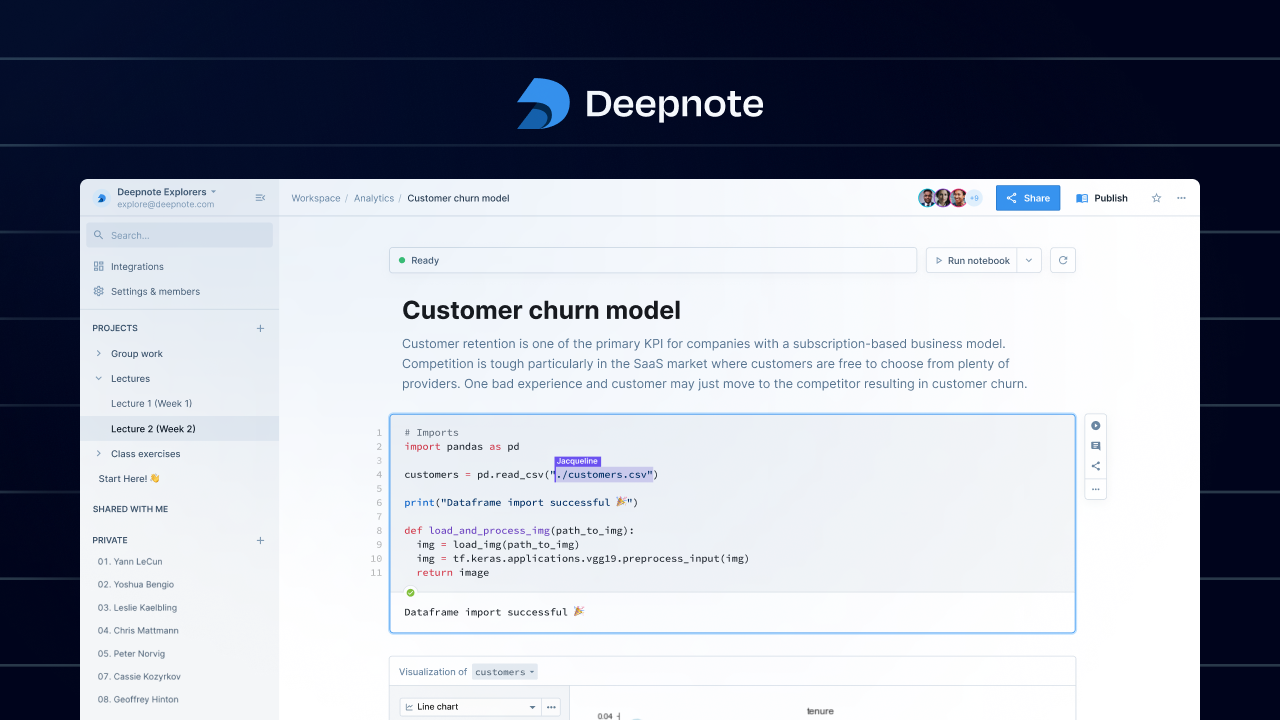

Deepnote is a cloud‑based notebook platform that lets multiple users write, run, and share Python and SQL code together in real time. It combines the familiar notebook experience with built‑in collaboration tools, version control, and instant visualizations. The platform integrates with popular data sources and version‑control systems, enabling teams to prototype, explore, and deploy analyses without leaving the browser. Deepnote’s focus on teamwork makes it ideal for data‑driven projects that require fast feedback and shared insights.
PopSQL is a browser-based SQL editor built for teams rather than individuals, with real-time collaborative editing, inline comments, and version history on saved queries. It connects to most mainstream warehouses and databases including PostgreSQL, Snowflake, BigQuery, MySQL, Redshift, Azure Synapse, and ClickHouse, and adds autocomplete backed by schema and usage statistics so analysts can find the right table faster. Beyond the editor, PopSQL turns query results into charts and lightweight dashboards with variables for self-service filtering, and can schedule queries to refresh on a cadence and post results to Slack. Now part of Timescale (TigerData), it's aimed at data teams that want a shared, searchable home for SQL work instead of queries scattered across individual notebooks and chat threads.
- Instant collaborative editing eliminates version‑conflict headaches.
- Supports both Python and SQL in the same environment.
- Integrated visualizations and charts update live.
- Cloud‑only, no local installation required.
- Real-time collaborative editing is genuinely useful for data teams working together
- Broad database and warehouse connector support
- Lightweight dashboards avoid needing a separate BI tool for simple reporting
- Viewers are free, so non-technical stakeholders can see results at no extra cost
- Limited offline access; requires internet connection.
- Advanced enterprise features are behind paid plans.
- Not open source, so customization is constrained.
- Per-editor pricing adds up for larger analytics teams
- Dashboarding is intentionally lightweight, not a replacement for full BI tools
- Advanced governance features like SSO and audit logs are Enterprise-only
More alternatives & similar tools
Alternatives to Deepnote
View all →

Alternatives to PopSQL
View all →The Verdict
AI-generated from listing dataDeepnote offers a full notebook environment with real‑time Python + SQL collaboration, while PopSQL focuses on collaborative SQL editing and lightweight dashboards.
Key differences
- •Deepnote mixes Python code and SQL in the same notebook; PopSQL is SQL‑only.
- •Deepnote provides built‑in visualizations that update live; PopSQL creates charts from query results but targets simple dashboards.
- •PopSQL includes schema‑aware autocomplete and broader database connector list; Deepnote’s key integrations are limited to Snowflake, BigQuery, GitHub, Slack, Google Drive.
- •Pricing model: Deepnote’s freemium is user‑based with paid plans for advanced features; PopSQL charges per editor, which can scale costlier for large teams.
Pricing & value
PopSQL’s per‑editor pricing can become expensive for big teams, but its free viewer mode adds value for stakeholder access.
Ease of use / learning curve
Deepnote’s notebook UI is familiar to data scientists; PopSQL’s SQL‑only interface is simpler for pure analysts.
Features & depth
Deepnote supports both Python and SQL, live visualizations, and Git versioning in one environment; PopSQL is limited to SQL queries and lightweight dashboards.
Integrations & ecosystem
PopSQL lists more database connectors (PostgreSQL, Snowflake, BigQuery) and schema‑aware autocomplete; Deepnote mentions only Snowflake, BigQuery, GitHub, Slack, Google Drive.
Collaboration
Both provide real‑time multi‑user editing, comment threads, and version history.
Scalability
Deepnote’s cloud‑only deployment with automatic environment provisioning scales notebooks without local installs.
Support
Deepnote offers email and live‑chat support; PopSQL’s support options are not specified.
Choose Deepnote if…
Teams needing Python + SQL notebooks, live visualizations, and unified version control.
Choose PopSQL if…
SQL‑centric analyst groups that want real‑time query editing, schema autocomplete, and simple shareable dashboards.
Common questions
Can I run Python code in PopSQL?
No, PopSQL is a SQL‑only editor; Python support is only available in Deepnote.
What happens if my team works offline?
Both products are cloud‑only; Deepnote explicitly notes limited offline access, and PopSQL’s offline capability is not specified.
Which tool offers more database connectors?
PopSQL lists PostgreSQL, Snowflake, BigQuery and others; Deepnote mentions Snowflake and BigQuery only.