



APEC ROES-100 Essence Reverse Osmosis System vs Ecowater ERO375
Side-by-side comparison of features, pricing, ratings, and alternatives.
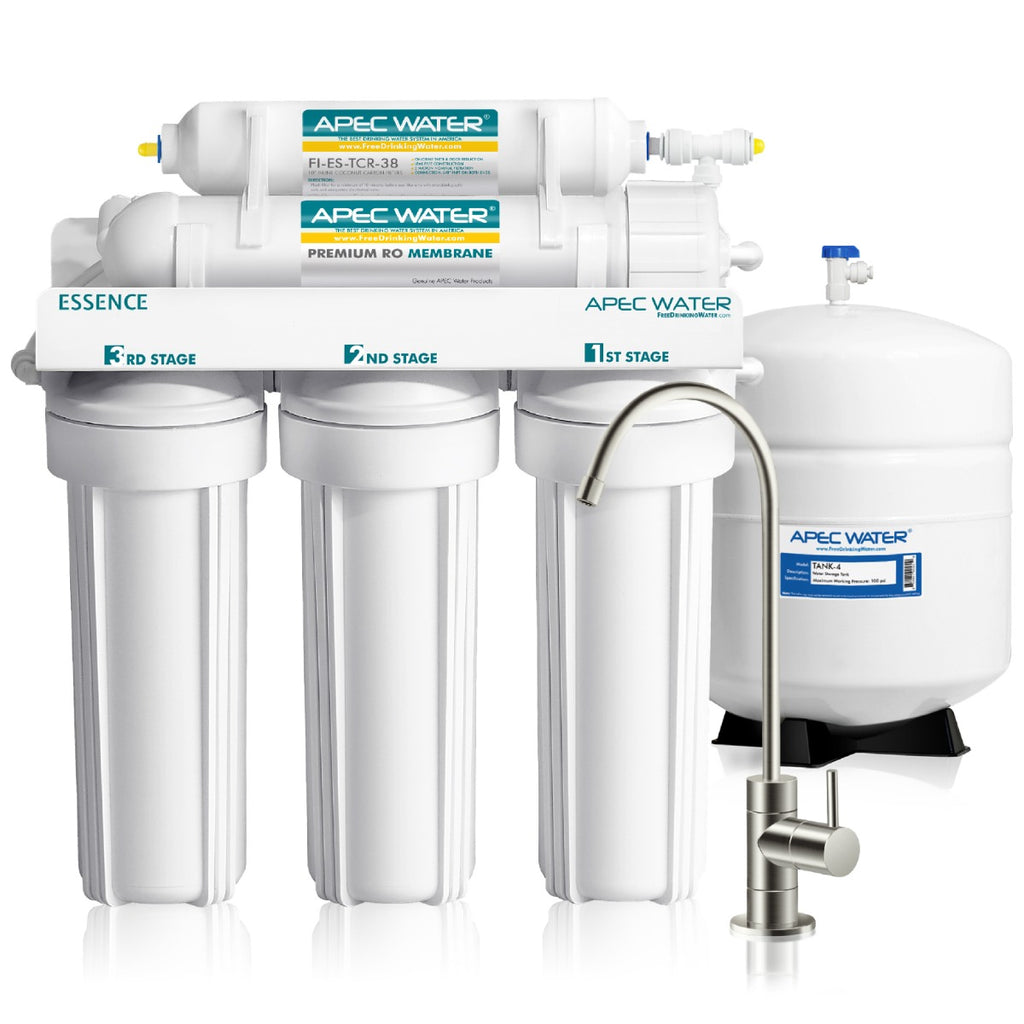

The ROES-100 is the high-output model in APEC's Essence series, a five-stage under-sink reverse osmosis system rated at 100 gallons per day. That capacity is the reason to choose it over the more common 50 GPD systems: a higher production rate means the storage tank refills faster, so a busy household is less likely to run the tank down between uses. APEC states the system removes up to 99 percent of contaminants. The five stages combine sediment and carbon pre-filtration, the RO membrane itself and a final polishing stage, which is the standard under-sink RO arrangement. APEC sells a deep catalogue around it: replacement filter sets, tanks, pumps, leak detectors, housings and faucets, plus alternative configurations including tankless, countertop, UV and pH-remineralising variants.
The Ecowater ERO375 is a 3‑stage reverse osmosis system designed for under‑sink installation, providing up to 75 gallons of purified water per day. It removes chlorine, lead, cysts, and other contaminants while retaining beneficial minerals for great‑tasting water. Ideal for families and health‑conscious individuals, the ERO375 features a sleek, space‑saving design and a dedicated faucet that delivers instant, ready‑to‑drink water straight from the tap.
- High 100 GPD output suits larger households
- Comprehensive spare parts and filter availability
- Standard under-sink installation with a dedicated faucet
- Part of a range so upgrades and variants are easy to find
- High contaminant removal efficiency
- Large daily output for family use
- Compact under‑sink installation
- NSF certified components
- Under-sink installation is not practical in most rentals
- RO systems produce wastewater alongside purified water
- Consumes cabinet space for the unit and the storage tank
- No built‑in smart monitoring
- Requires regular filter and membrane replacement
- Initial installation may need a plumber for optimal setup
More alternatives & similar tools
Alternatives to APEC ROES-100 Essence Reverse Osmosis System
View all →
Pure drinking water at the tap with 99.9% contaminant removal

Tankless under‑sink RO system delivering 800 gallons per day of pure water.

Alternatives to Ecowater ERO375
View all →Tankless under‑sink RO system delivering 800 gallons per day of pure water.
High-capacity 5-stage under-sink RO system producing 100 gallons per day.
Pure drinking water at the tap with 99.9% contaminant removal
The Verdict
AI-generated from listing dataThe Ecowater ERO375 offers higher build quality and certification for a typical family, while the APEC ROES-100 gives more daily output at a lower price.
Key differences
- •Daily output: 75 gpd (Ecowater) vs 100 gpd (APEC).
- •Price: $599 (Ecowater) vs $239.95 (APEC).
- •Warranty: 1 year (Ecowater) vs not specified (APEC).
- •Physical size: Ecowater 13×7×15 in; APEC dimensions not provided.
- •Certification: Ecowater NSF/ANSI certified; APEC certification not specified.
Capacity (gallons per day)
APEC produces 100 gpd, 25 gpd more than Ecowater’s 75 gpd.
Price
APEC costs $239.95, substantially less than Ecowater’s $599.
Warranty
Ecowater provides a 1‑year warranty; APEC warranty not specified.
Size & footprint
Ecowater dimensions are 13×7×15 in; APEC dimensions are not given, so Ecowater is known to be compact.
Certification
Ecowater’s components are NSF/ANSI certified; APEC certification is not mentioned.
Ease of maintenance
Both require regular filter/membrane changes; no smart monitoring for either.
Warranty
Ecowater offers a 1‑year warranty; APEC warranty not specified.
Choose APEC ROES-100 Essence Reverse Osmosis System if…
Larger households needing higher daily output and lower upfront cost.
Choose Ecowater ERO375 if…
Homeowners wanting certified, compact RO with solid warranty for a typical family.
Common questions
Which system is cheaper to buy?
APEC ROES-100 costs $239.95, while Ecowater ERO375 costs $599.
Will either system fit in a small under‑sink space?
Ecowater’s dimensions are 13×7×15 in, designed for tight spaces; APEC size isn’t listed, so fit cannot be confirmed.
Do either of the systems have smart monitoring?
No; both systems lack built‑in smart connectivity.